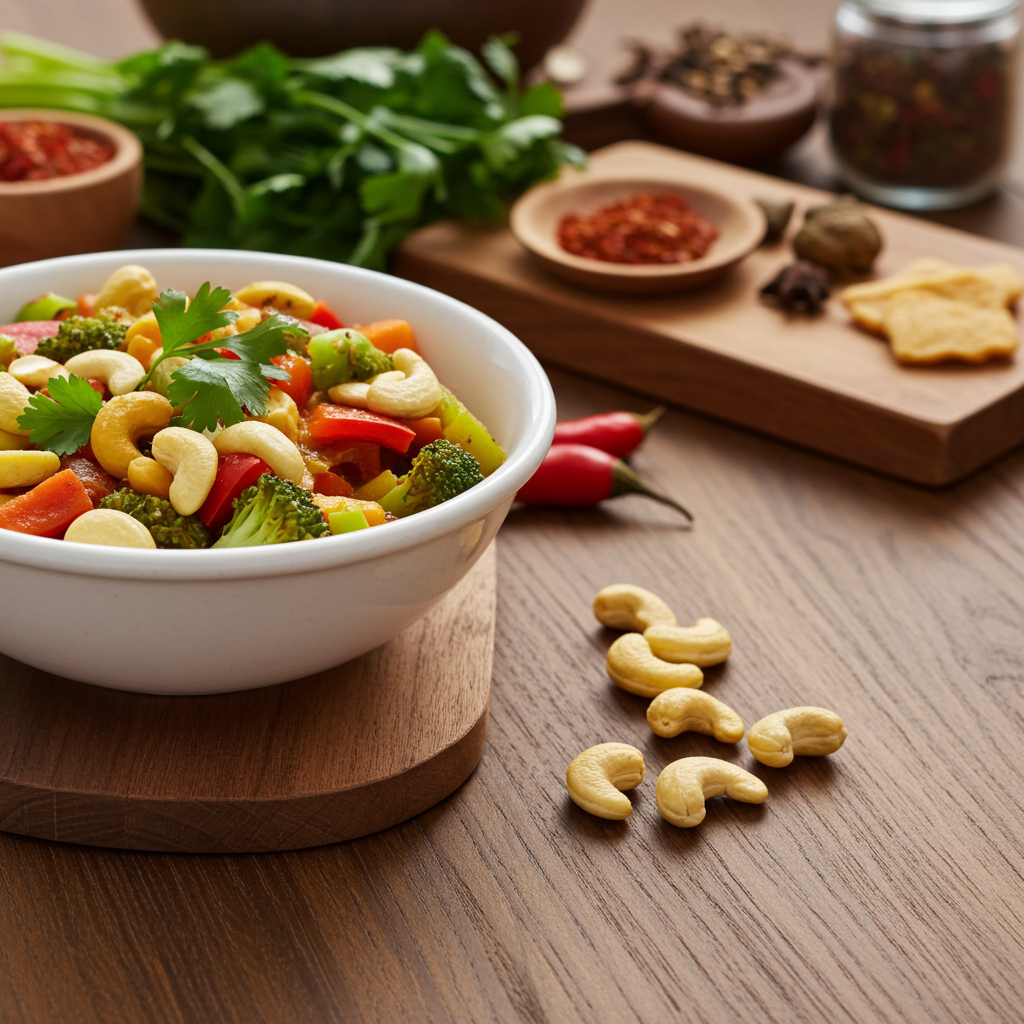
Their delicate, creamy, and mild flavor makes cashew nuts a popular snack. Cashew nuts can be used in a wide variety of ways, such as in muesli, salads, desserts, vegetable and meat dishes, and trail mix.
Cashew nuts are the drupes of the cashew tree (Anacardium occidentale), which can grow up to twelve meters tall. Cashew trees, also known as cashew trees, belong to the cashew family and reach heights of up to 12 meters. They are native to Brazil but are now also cultivated in Africa, Asia, and Latin America. Cashew trees bear so-called cashew apples, which are pear- or bell pepper-shaped "false fruits." The cashew kernels are not located inside the cashew apple, but rather on its outer skin in the actual, much smaller fruit called the "elephant louse."
The kidney-shaped, 2-3 cm, light-colored cashew nuts contain a particularly high amount of minerals such as calcium, magnesium, iron, phosphorus, and copper. Cashew nuts also have a high vitamin content, especially vitamins B1, B3, and B5. Additionally, cashew nuts are especially rich in tryptophan, an essential amino acid.
Origin: India, Vietnam
Description: untreated cashew nuts
Ingredients: Cashew nuts (largest)
Storage: cool (10-15°C), dry and dark
Appearance: light ivory to slightly greyish cashew kernels,
isolated dark discolorations
Scent: characteristic, nutty, like cashew, without any foreign odor
Taste: characteristic, nutty, cashew-like, without any off-flavors
Consistency: firm to the bite, crunchy
Allergens :
Please note that our products may contain traces of gluten, soy, nuts, almonds, peanuts, milk (lactose), sesame and sulfur dioxide (sulfites) .
Average nutritional values: (per 100g)
Energy (in kJ): 2415
Energy (in kcal): 582
Fat: 43.9 g
- of which saturated fatty acids: 7.8 g
Carbohydrates: 26.9 g
- of which sugars: 5.9 g
Dietary fiber: 3.3 g
Protein: 18.2 g
Salt: 0.03 g