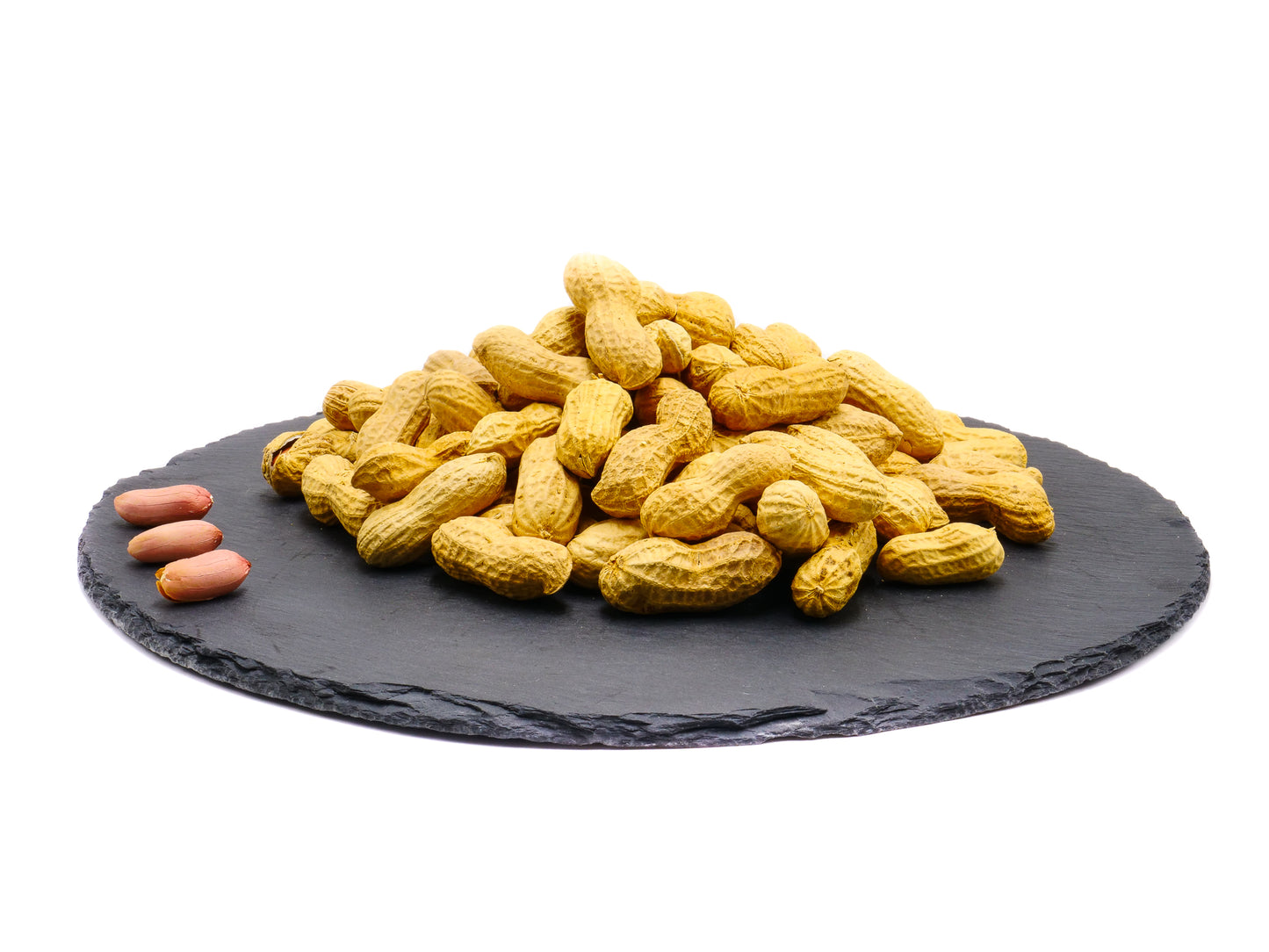
Peanuts are among the plant-based foods richest in magnesium. They provide essential amino acids, vitamins, minerals, and phytochemicals. Peanuts contain no cholesterol but are rich in unsaturated fatty acids.
Peanuts belong to the legume family – so they aren't actually nuts, but rather related to peas and beans. The name "peanut" comes from the fact that these legumes grow underground, meaning they are geocarpic. Originally, the peanut plant is native to the Andes Mountains of South America, but today it is cultivated throughout the tropics and subtropics. The elongated, slightly curved fruit walls, which contain two to three almost egg-shaped, light brown seeds, have a net-like surface structure.
Peanuts can be enjoyed raw, roasted, boiled, or as a nut butter. Freshly harvested peanuts are always dried, reducing their water content from 40% to 5-10%. Raw peanuts are available with or without their shells. Their flavor, reminiscent of their close relatives peas and beans, is well-suited for baking, cooking, adding to muesli, or snacking.
Origin: Egypt
Description: Roasted, whole peanuts in their shells
Ingredients: Peanuts
Storage: cool (10-15°C), dry and dark
Look:
- Bowl: beige to greyish, matte surface
- Kernel: beige to light brown kernels, with a reddish-brown seed coat
Odor: characteristic, very aromatic, without any foreign odor
Taste: characteristic, aromatic, peanutty, without any off-flavors
Consistency: crisp, firm to the bite
Allergens :
Please note that our products may contain traces of gluten, soy, nuts, almonds, peanuts, milk (lactose), sesame and sulfur dioxide (sulfites) .
Average nutritional values: (per 100g)
Energy (in kJ): 2552
Energy (in kcal): 617
Fat: 51 g
- of which saturated fatty acids: 10 g
Carbohydrates: 10 g
- of which sugars: 5.9 g
Protein: 24 g
Salt: 0.04 g